The ADA Title II deadline shifted, but the obligation didn’t. Accessibility has been required for decades. Start with your key user journeys and fix what matters.
You may have seen the recent update to Title II of the Americans with Disabilities Act (ADA), which extends the compliance deadline to April 26, 2027 (or 2028, depending on entity size).
That might sound like you have more time.
You don’t.
Adding WCAG 2.1 AA as a requirement doesn’t create a new obligation. It clarifies one that already existed.
The Legal Landscape Today:
- Accessibility Law at a Glance
- The Floor Never Moved
- Title III
- Title II
- Title I
- Section 504
- Section 508
- What This All Means
Accessibility Law at a Glance
The regulatory picture for digital accessibility is unsettled right now. Deadlines extended. Rules challenged! Standards debated.
None of that changes the underlying obligation.
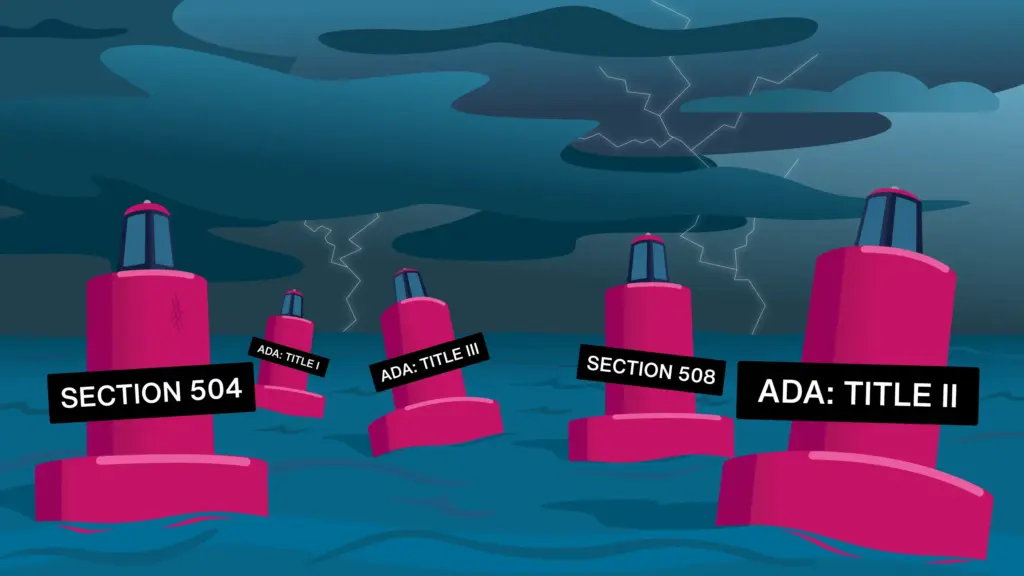
Here’s what US law has always said, across all five frameworks:
- Title III covers private businesses. Courts ruled in 2006 (NFB v. Target) and 2019 (Robles v. Domino’s) that the Americans with Disabilities Act (ADA) applies to websites. No Web Content Accessibility Guidelines (WCAG) requirement is codified here, but the Department of Justice (DOJ) has officially taken the position that the ADA covers web content since 1996.
- Title II covers state and local governments. The 2024 rule that just had its deadline extended? It codified obligations that have existed since 1992. The DOJ has been settling digital accessibility cases with cities and universities for decades.
- Title I covers employers. Equal Employment Opportunity Commission (EEOC) guidance from 2002 explicitly requires employers to make digital tools accessible to employees with disabilities. Recent settlements – including $1.25M against a staffing agency in 2024 and multiple screen reader cases in 2025 – prove it has teeth.
- Section 504 covers anyone who accepts federal financial assistance. The statute is from 1973. Hospitals, universities, nonprofits – if you take federal money, the nondiscrimination obligation is older than the internet.
- Section 508 covers federal agencies and their technology: both what they build and what they buy. WCAG 2.0 AA was written into federal law in 2018. If you’re a federal agency or selling technology to one, this has been your floor for over seven years.
The Floor Never Moved
Have you ever confused a map with the terrain it represents?
That’s exactly what’s happening in digital accessibility right now. Deadlines are shifting. Rules are being challenged. An Interim Final Rule dropped on April 17, 2026, extending the Americans with Disabilities Act (ADA) Title II compliance deadline by a full year. States are in court trying to dismantle Section 504 regulations.
And into that noise, a troubling argument has started to emerge: if the technical standards aren’t firmly codified, maybe the requirement itself is softer than we thought.
It’s like crossing into New Hampshire and seeing this sign:

Some people read “common sense for all” as optional.
The physics of a crash don’t.
The map can change. The terrain doesn’t.
The floor – the fundamental legal obligation to make digital content accessible to people with disabilities – has not moved. It was never where people thought it was. It was always lower, older, and more deeply embedded than any single regulation or deadline.
There are five legal frameworks governing digital accessibility in the United States. Together, they cover private businesses, government bodies, employers, federally funded organizations, and federal technology procurement.
Different histories, different enforcement. Same conclusion: all of them have required some form of digital accessibility for far longer than most compliance conversations acknowledge.
Title III: where the case law was built
Title III of the Americans with Disabilities Act covers private businesses and nonprofits that serve the public – places of public accommodation. And for most of the last two decades, Title III has been where the legal battles over digital accessibility were fought.
The reason is simple: Title III allows private lawsuits without the administrative hurdles required under other frameworks. Individuals and organizations could go directly to court, and they did.
The foundational case is National Federation of the Blind v. Target Corporation, 452 F. Supp. 2d 946 (N.D. Cal. 2006). The NFB sued Target over an inaccessible website – missing alternative text, no keyboard navigation, unlabeled forms. The court certified a nationwide class action and ruled that commercial websites are required to be accessible under the ADA. This was the first precedent of its kind in the country for commercial websites. The case settled in 2008 for $6 million.
Thirteen years later, the Ninth Circuit answered the next obvious question in Robles v. Domino’s Pizza, LLC, 913 F.3d 898 (9th Cir. 2019). Guillermo Robles, who is blind, couldn’t order a pizza or access online coupons through Domino’s website or app. Domino’s argued that the ADA simply didn’t apply to online platforms that weren’t contemplated when the law was written in 1990. The Ninth Circuit disagreed, holding that “the ADA applies to the services of a place of public accommodation, not services in a place of public accommodation.” The Supreme Court declined to review the decision in October 2019, letting the ruling stand.
Domino’s also argued it couldn’t be held to a standard that didn’t yet exist in regulations. The Ninth Circuit rejected that too, finding that Domino’s had been on notice since 1996 of the Department of Justice’s position that its website and app must provide effective communication. That 1996 marker matters. The Department of Justice (DOJ) has stated directly on ada.gov: “Since 1996, the Department of Justice has consistently taken the position that the ADA applies to web content.” That’s nearly three decades of official notice, across administrations of every political persuasion.
Here is what Title III does not have: a specific codified technical standard. There is no Title III equivalent of a rule requiring WCAG 2.1 AA (Web Content Accessibility Guidelines). What exists instead is the general statutory obligation – don’t discriminate, provide effective communication, give people with disabilities equal access to your goods and services – with courts and DOJ settlements converging on WCAG as the practical measure. If the regulatory picture creates confusion, the underlying obligation remains untouched.
Title II: the government obligation that never needed case law
Title II of the ADA covers state and local governments, including every department, agency, university, school district, and public body at the state and local levels. Here, the argument that digital accessibility is a recent imposition collapses almost immediately.
In April 2024, the DOJ issued its Final Rule specifying WCAG 2.1 AA as the required technical standard for government websites and apps. In April 2026, the compliance deadline was extended by one year via Interim Final Rule – now April 26, 2027 for larger entities, April 26, 2028 for smaller ones. No other requirements changed. The standard stayed exactly where it was.
But the 2024 rule was not the beginning of the obligation. It was the codification of one that already existed.
The DOJ’s own fact sheet for the 2024 rule describes it as setting “a specific technical standard that state and local governments must follow to meet their existing obligations under Title II.” That phrasing is deliberate. The existing obligations are found in Title II’s implementing regulations, in place since 1992:
§35.160 – Effective Communication requires public entities to ensure communication with people with disabilities is “as effective as communication with others.” As government services moved online, the medium changed. The obligation didn’t.
§35.150 – Program Access requires public entities to make their programs and activities accessible in their entirety. Programs don’t become inaccessible to the law just because they’re delivered digitally.
§35.130 – General Nondiscrimination is the broad prohibition on excluding people from participation on the basis of disability. “Except on the internet” has never appeared in that section.
The enforcement record confirms that governments knew this. The DOJ’s Project Civic Access initiative produced hundreds of settlement agreements with cities and counties – including Denver, Jacksonville, and Durham – requiring web accessibility compliance years before the 2024 rule existed. The Department of Education (DOE)’s Office for Civil Rights (OCR) used WCAG as its yardstick in investigations for over a decade before the rule was published. The Michigan Alliance for Special Education filed more than 2,400 web accessibility complaints against schools and districts under Title II and Section 504 combined, resulting in more than 1,000 resolution agreements.
The University of California, Berkeley entered a 3.5-year consent decree requiring it to make existing online content accessible – including lectures, conferences, and sporting events on YouTube, Apple Podcasts, and BerkeleyX – content that lacked captions, transcripts, alternative text, and screen reader compatibility. That consent decree predated the 2024 rule. The obligation didn’t.
Converge Accessibility put it plainly in March 2026: “The new rule doesn’t create a new obligation. It codifies one that already exists. The only thing that changed in 2024 is that the DOJ clarified the regulation and made WCAG explicit. The obligation to provide effective communication and non-discriminatory treatment for people with disabilities on websites has been there since 1992.”
Pulling the rule back, extending its deadlines, or challenging it in court doesn’t touch that 1992 floor.
Title I: the sleeper obligation
Title I of the ADA governs employment – specifically, the obligations of covered employers with 15 or more employees. It’s the title that tends to drop out of digital accessibility conversations, because, unlike Titles II and III, it doesn’t generate the same litigation patterns. That absence is sometimes misread as an absence of obligation. It isn’t.
Title I’s mechanism is different from the others. Where Titles II and III carry proactive, systemic obligations – make your services accessible, for everyone, before anyone complains – Title I operates through individualized reasonable accommodation. The trigger is a known qualified individual with a disability making a specific request. The employer must then engage in an interactive process and provide accommodation unless it creates undue hardship.
Digital accessibility has always been covered under this framework. The Equal Employment Opportunity Commission (EEOC)’s Revised Enforcement Guidance on Reasonable Accommodation and Undue Hardship Under the Americans with Disabilities Act, No. 915.002 (Oct. 17, 2002) makes this explicit: “Employers must ensure that employees with disabilities have access to information that is provided to other similarly-situated employees without disabilities, regardless of whether they need it to perform their jobs.” The guidance further specifies that when an employer upgrades computer equipment, it must provide new adaptive equipment to accommodate employees who need it, absent undue hardship. That guidance was published in 2002. Screen readers existed. The internet existed. The obligation existed.
The enforcement record makes the scope of this obligation concrete.
- In EEOC v. Pearson Education (filed 2025), the EEOC alleged that Pearson contracted with third-party vendors to provide online platforms that employees were required to use for benefits, leave, and training – and that employees who are blind or have visual impairments and rely on screen reading software could not access their own employment information because the portals were inaccessible. Pearson was aware of the problem and failed to provide accommodation.
- In EEOC v. The Results Companies (settled 2025, $250,000), the company failed to accommodate an employee who needed screen reader software, refused her suggestion to contact her vocational counselor or the software publisher for technical assistance, and ultimately terminated her employment. The EEOC’s Dallas office was unambiguous: “This obligation can extend to the employer addressing compatibility and other technical issues to allow for the use of accessibility software such as screen readers, screen magnifiers, and voice-to-text programs.”
- In EEOC v. National Telecommuting Institute (settled 2024, $1.25 million), the EEOC charged that NTI screened out blind and low-vision job applicants from telephone-based customer service roles upon learning they used screen readers – presuming without inquiry that client employers couldn’t support the technology. The EEOC described these as “unnecessary and exclusionary barriers to employment opportunities since at least 2017.”
- In EEOC v. Cloudbeds (settled 2023, $150,000), a remote-first technology company terminated a deaf applicant in IT administration after refusing to accommodate his use of American Sign Language during the hiring process, determining that verbal communication was a job requirement without engaging in the required interactive process.
The pattern is clear and consistent. Employers are obligated to ensure that digital systems – hiring portals, HR platforms, benefits tools, training content, internal communications – are accessible to employees and applicants with disabilities who need them. The mechanism is individualized and reactive rather than proactive and systemic, which is why it surfaces in different ways than Titles II and III. The obligation has always been there.
Section 504: the oldest floor of all
Section 504 of the Rehabilitation Act of 1973 is the oldest piece of this puzzle. It predates the ADA by 17 years. It predates the web by two decades. And its language is striking in its directness:
“No otherwise qualified individual with a disability shall, solely by reason of her or his disability, be excluded from the participation in, be denied the benefits of, or be subjected to discrimination under any program or activity receiving Federal financial assistance.”
That sentence was written in 1973. It doesn’t say “physical programs.” It says programs.
Section 504 is also the first federal civil rights law explicitly protecting people with disabilities from discrimination. It established the legal architecture that the ADA would later build on, and it remains independently enforceable today across an extraordinarily broad range of organizations.
Section 504’s reach is defined not by what entities are, but by what they accept. Federal financial assistance triggers coverage, and that net is wide. Medicare Part B reimbursement alone is enough. Federal student loans flowing to a university are enough. A Health and Human Services (HHS) grant to a nonprofit is enough. Most hospitals, physician practices, federally qualified health centers, health plans, research institutions, medical schools, and human services programs fall within its scope.
HHS issued its own 2024 Final Rule under Section 504, codifying WCAG 2.1 AA as the required technical standard for covered organizations, effective July 8, 2024. The compliance deadline for larger organizations to meet that specific technical standard is May 11, 2026. But HHS’s own detailed fact sheet for the rule is instructive about what that means: the 2024 rule “includes regulatory provisions that mirror the ADA’s requirements for public and private health care providers and social service providers, which have applied to recipients for years.” The codification date and the compliance deadline are not the same as the beginning of the obligation – and even that understates it.
Section 504’s nondiscrimination obligation is fifty years old. OCR has been settling digital accessibility cases in education and healthcare for years before 2024.
Texas v. Kennedy, the ongoing case in which nine states are challenging the HHS 2024 regulations, is worth understanding clearly for what it is and isn’t. The states are challenging specific regulatory provisions – particularly around the integration mandate and Olmstead community living protections. Notably, these same states withdrew their earlier claim that Section 504 itself is unconstitutional. The statute stands. Whatever happens to the 2024 regulations, inaccessible delivery of federally funded programs and services has been legally discriminatory since the year of the Watergate hearings.
Section 508: where WCAG is already law
Section 508 of the Rehabilitation Act rounds out this picture, and it is the framework that makes the “we didn’t know what was required” argument hardest to sustain anywhere in the digital accessibility space.
The original Section 508 was added to the Rehabilitation Act in 1986, though it initially lacked meaningful enforcement mechanisms. Congress strengthened it substantially in 1998, adding enforcement teeth and a private right of action. The 1998 amendments require all federal agencies to ensure that the electronic and information technology they develop, procure, maintain, or use is accessible to people with disabilities – employees and members of the public alike – with access comparable to that available to people without disabilities.
Then, in 2017, the U.S. Access Board published the Section 508 Refresh – a comprehensive update that explicitly aligned the standards with WCAG 2.0 Level AA. This took effect in January 2018. WCAG has been written into federal procurement law for over seven years.
The coverage of Section 508 is distinct from the other frameworks here. It applies to federal agencies directly, and it extends to any contractor, vendor, or organization that wants to sell technology products or services to the federal government. If you’re building software, platforms, or digital tools for federal clients – or hoping to – Section 508 compliance is a procurement requirement, not just a legal aspiration.
The enforcement path under Section 508 involves filing an administrative complaint with the relevant agency first, after which individuals may pursue a civil action. In Orozco v. Garland, 60 F.4th 684 (D.C. Cir. 2023), the D.C. Circuit confirmed that this private right of action is available to both federal employees and members of the public who experience inaccessible federal technology – reversing a lower court’s more restrictive reading of the statute.
The significance of Section 508 in this broader picture is straightforward: it is the framework where WCAG has been the most explicitly codified, for the longest time. The 2017 Refresh didn’t arrive in a regulatory vacuum – it built on Section 508 standards that had been in place since 2000, which themselves built on an obligation established in statute in 1998. The floor here has been poured, set, and walked on for a quarter century.
For any organization operating in or adjacent to the federal market, “we weren’t sure what the standard was” has not been a credible position since the Clinton administration.
What This All Means
Five frameworks. Five different coverage mechanisms. Multiple enforcement agencies.
One consistent answer to the question: has digital accessibility always been required?
Yes.
Not WCAG 2.1 AA specifically. Not a particular version number or deadline.
But accessible? Yes! For every covered entity, going back decades.
The obligations were always there: in statute, in regulation, in guidance, in settlements, in case law.
What changed recently is specificity. Measurement. A named technical benchmark.
When a compliance deadline extends, the deadline moves. The law does not.
When a regulation is challenged, the regulation is at risk. The statute is not.
When an administration signals it may revisit the rules, the rules may change. The underlying obligation – not to exclude people with disabilities from your programs, services, employment, and goods – does not.
The rules might be changing. The game isn’t.
Jessica Chambers, CPWA is a Senior Product Enablement Specialist and Accessibility Evangelist at Silktide and the author of Don’t Panic: It’s Just Accessibility. She grew up in New Hampshire, where “common sense for all” wasn’t considered optional. This article does not constitute legal advice.