Technology
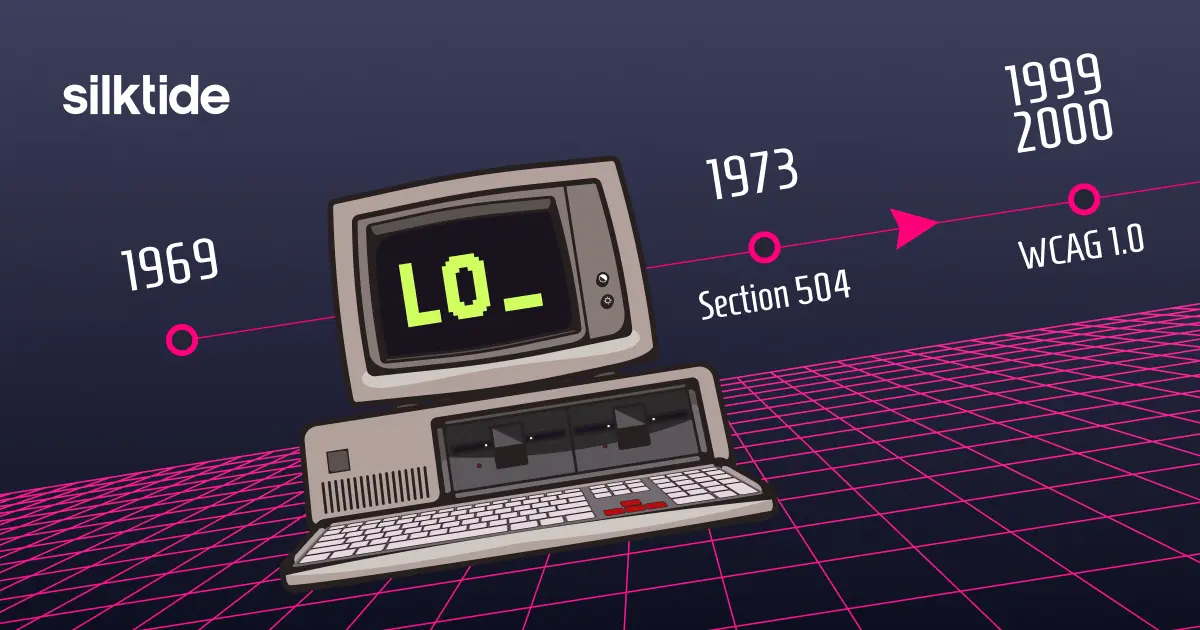
ARPANET goes live
Four university computers. One network. The first message sent was “LO” – they were trying to type “LOGIN” when the system crashed.
Nobody was thinking about accessibility yet – not because it didn’t matter, but because the network was small, technical, and closed. The assumptions baked in here would scale. The audience would too.
Civil rights
Section 504, Rehabilitation Act
The most important sentence in disability law:
“No otherwise qualified individual with a disability in the United States shall, solely by reason of her or his disability, be excluded from the participation in, be denied the benefits of, or be subjected to discrimination under any program or activity receiving Federal financial assistance.”
Section 504, Rehabilitation Act of 1973
Forty-five words. No enforcement mechanism. No funding. No plan. But the line had been drawn. Section 504 was born.
Ten years pass…
Technology
TCP/IP: a common language
Vint Cerf and Bob Kahn gave the internet a universal protocol. On January 1st, every machine on ARPANET switched overnight. The internet could now speak to itself. Universal – in theory.
Technology
Domain names go live
Instead of memorizing 192.168.1.1, you could type words. There’s no place like 127.0.0.1. The internet was becoming human-readable. For some humans.
Civil rights
Americans with Disabilities Act
Curb cuts. Ramps. Accessible restrooms. Physical spaces finally had rules. The web – still being invented in a Geneva laboratory – wasn’t mentioned, and as a result digital ADA violations are still common today.
Technology
The World Wide Web
Tim Berners-Lee launches the first webpage at CERN. Text-based. Linear. Predictable.
It wouldn’t stay that way for long.
The web grows. Images. JavaScript. Flash. No rules.
Technology
Simple interface. Massive reach. The web is no longer experimental. It’s infrastructure. And whatever works – or doesn’t – now affects everyone. With the advent of a modern search engine, SEO develops.
The web was eight years old before anyone wrote down the rules for who it had to work for.
Convergence
The rules arrive – finally
Standards – 1999
WCAG 1.0
Eight years after the first webpage: fourteen guidelines. Text equivalents for images. Keyboard navigation. Color contrast. Skip links. The rules existed. Adoption did not.
Federal law – 2000
Section 508 standards
Federal agencies must make their websites accessible. Similar to WCAG 1.0, but their own standard. Good enough for 2000. Not updated for eighteen years.
Technology
Usability becomes mainstream
“Don’t make me think.”
A generation of designers learns to simplify interfaces. Reduce friction. Make things easier to use.
But “me” wasn’t everyone. And for a long time, that wasn’t seen as a problem. In many places, it still isn’t.
The rules exist. The web ignores them and accelerates.
Technology
The social web
The web stops being pages and starts being social media interactions. Profiles. Feeds. Video. Real-time updates.
Complexity explodes. Accessibility becomes harder to maintain – and easier to ignore. The rules exist. The platforms move faster.
Technology
WCAG 2.0 – the architecture
The architecture changes.
Perceivable. Operable. Understandable. Robust.
POUR wasn’t just another version. It was the structure everything else would be built on.
Technology
The mobile web
A second version of the internet appears: smaller, simpler, stripped down. No heavy JavaScript. Fewer moving parts.
Not designed for accessibility – just designed for smaller screens and worse connections. And yet…
Convergence
Two webs, one choice
The pattern is clear. The “full” desktop web is powerful, but often unusable. The mobile web is limited, but often easier to navigate.
Screen reader users start choosing the mobile version on purpose. Not because it’s better designed. Because it’s less broken. Twitter’s mobile site becomes a workaround. A simpler interface. Fewer traps.
Accessibility wasn’t missing. It was uneven – and users had to find the version that worked.
Convergence
Convergence — 18 years later
Federal law – January 2018
Section 508 refresh
The federal government finally updates its accessibility requirements. WCAG 2.0 Level AA becomes the standard – ten years after it was published.
Civil rights
ADA Title II: a standard, then a delay
In 2024, the Department of Justice finally named a standard. WCAG 2.1 Level AA. By then, WCAG 2.2 had already been published. State and local government websites, with clear deadlines.
On April 20, 2026, those deadlines were pushed back by a year.
In explaining why, the DOJ quoted their own 2017 reasoning – that they had withdrawn earlier rulemaking because they were evaluating whether specific standards were even “necessary and appropriate” to ensure ADA compliance.
They eventually decided yes. Then delayed the deadline anyway.
But the same document makes one thing plain:
“Regardless of the compliance dates, covered entities have an ongoing obligation to ensure that their services, programs, and activities offered using web content and mobile apps are accessible to individuals with disabilities in accordance with their existing obligations under title II of the ADA.”
The standard is delayed. The obligation isn’t. It never was.
Because this was never just about compliance.
“And not just the right thing; it’s profoundly the right thing to do, because the one argument for accessibility that doesn’t get made nearly often enough is how extraordinarily better it makes some people’s lives. How many opportunities do we have to dramatically improve people’s lives just by doing our job a little better?”
– Steve Krug, Don’t Make Me Think
You’ve always had to do the work.
So get going.